Education Landscape
Why medical degrees require enhancement

Switzerland is facing some serious challenges when it comes to medical care. There is a shortage of doctors in basic medical care in particular, while the healthcare sector is heavily reliant on medical specialists from other countries. The nature of the profession is also changing: prospective doctors are facing new requirements posed by digitalization, artificial intelligence, precision medicine and interprofessional cooperation. What is more, admission procedures need to be designed so as to be transparent and fair, as well as traceable when it comes to selecting eligible students.
With this in mind, University Medicine Zurich (UMZH) and Swiss universities offering programs in human medicine were commissioned by the Chamber of Universities of the swissuniversities association to investigate how medical degrees in Switzerland can be enhanced. The report was written within the scope of implementation of the Roduit and Hurni parliamentary motions. It describes the current situation and the required measures, while formulating recommendations for admission, the number of places, and education in human medicine in universities and clinical setting. The report is part of a comprehensive reform process. Changes to medical degrees alone will not suffice: Measures concerning continuing further education, employment conditions and healthcare policy are also crucial factors, particularly in terms of improving healthcare in the long term.
More places and up-to-date education
The number of places needs to increase significantly in order to train more doctors and counteract the shortage of doctors. This requires additional infrastructure, teaching staff and clinical education places, as well as enhanced support for trainee doctors, while digital teaching methods, simulation-based learning and clinical experience at an early stage should be incorporated in education to a greater extent. A nationally harmonized admission system should take account of communication and social skills as well as cognitive performance.
Improving basic medical care
Special attention should be paid to basic medical care. General practice, pediatrics, psychiatry, and child and adolescent psychiatry should be more firmly embedded during studies and education and be made more visible and appealing for young people considering a medical career. This would attract more doctors to work in fields in which supply requirements are especially high.
Key recommendations

Modernize admission
The admission systems for medical degrees should be harmonized across Switzerland. In addition to cognitive abilities, consideration should also be given to social and communication skills, motivation level and other non-cognitive skills. The goal is to achieve a transparent, fair and multi-dimensional process that provides proper justification for selection while recognizing the requirements of the medical profession.

Create more spaces
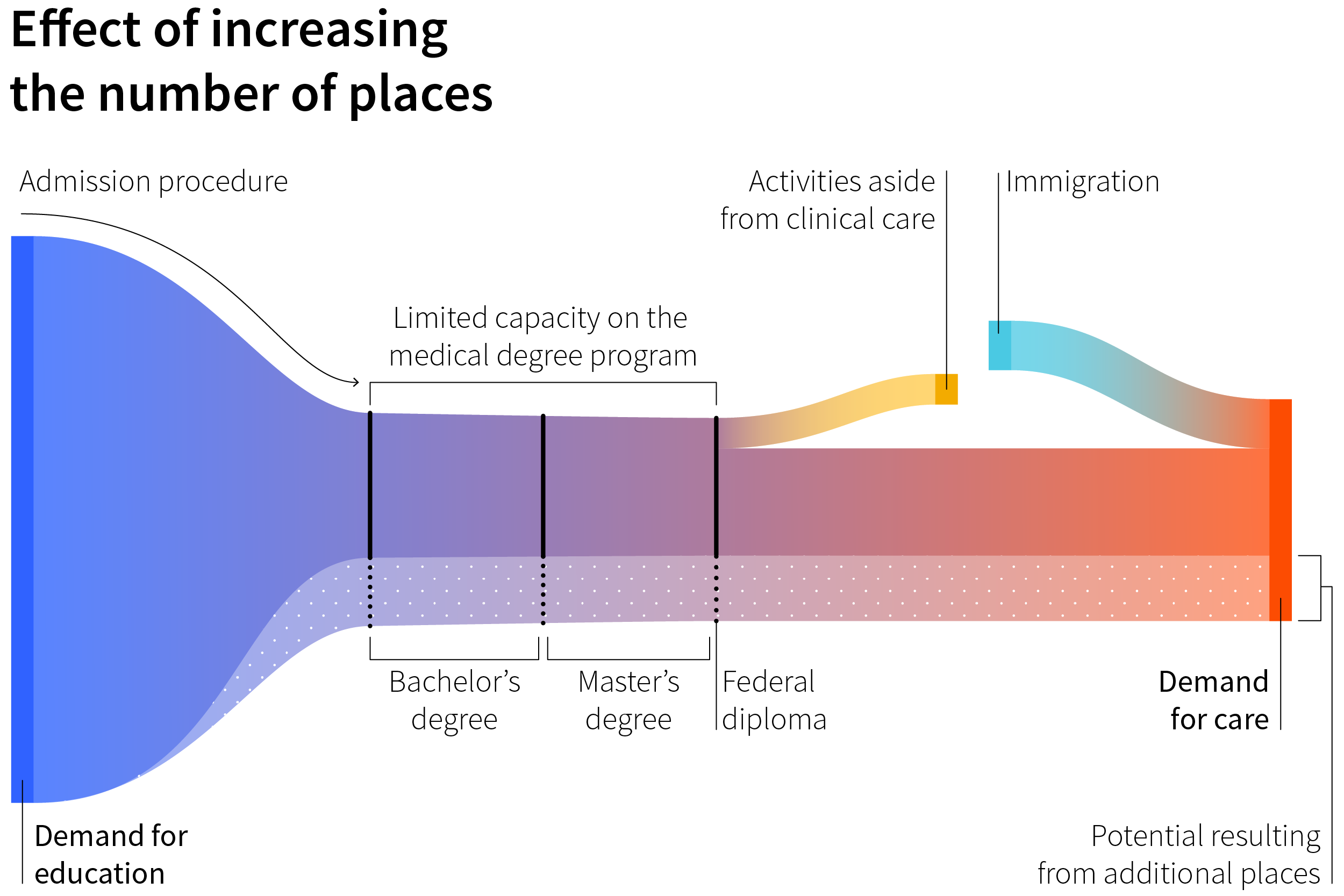
To meet the demand for doctors more effectively in the long term, a significant increase in the number of places is recommended. To achieve this, a second special program in human medicine should be launched, while investment is required in infrastructure, teaching staff and training opportunities in higher education institutions.

Improve clinical training
The increase in places also requires the creation of additional clinical training places. Hospitals and outpatient practices should be more closely involved and cooperation expanded at regional and national level. Lecturers and clinical trainers should receive more targeted support and have their training achievements recognized in a more meaningful way.

Ensure education is fit for the future
Medical education should be rigorously enhanced with a focus on skills. Digitalization, artificial intelligence, simulation-based learning, precision medicine, interprofessional cooperation and practical experience at an early stage should be appropriately integrated into the curricula. At the same time, efforts should be made to boost the profile and appeal of basic healthcare, including pediatrics, psychiatry, and child and adolescent psychiatry and psychotherapy.
Goal: What can the re-design achieve?
The measures are intended to ensure reliable medical care, increase the number of propective medical students in Switzerland, and reduce dependency on professionals from other countries. Practical training and a greater focus on basic care are intended to improve preparation for future requirements and the needs of the population.
The re-design has been planned over the long term: Work on degree programs and further education will begin once the necessary political, financial and organizational conditions are in place, meaning that the impact on healthcare will not be noticeable for some time. Universal coordination of admission, studies, further education and professional practice is a key factor.